
The short version: domestic CCTV is legal, but there are important rules
Installing CCTV on your own property in the UK is entirely legal. But if your cameras capture images beyond your property boundary — even partially — the law gets more involved.
Here's a practical breakdown of what the rules mean for a typical South Wales homeowner.
The key legislation
UK GDPR and the Data Protection Act 2018
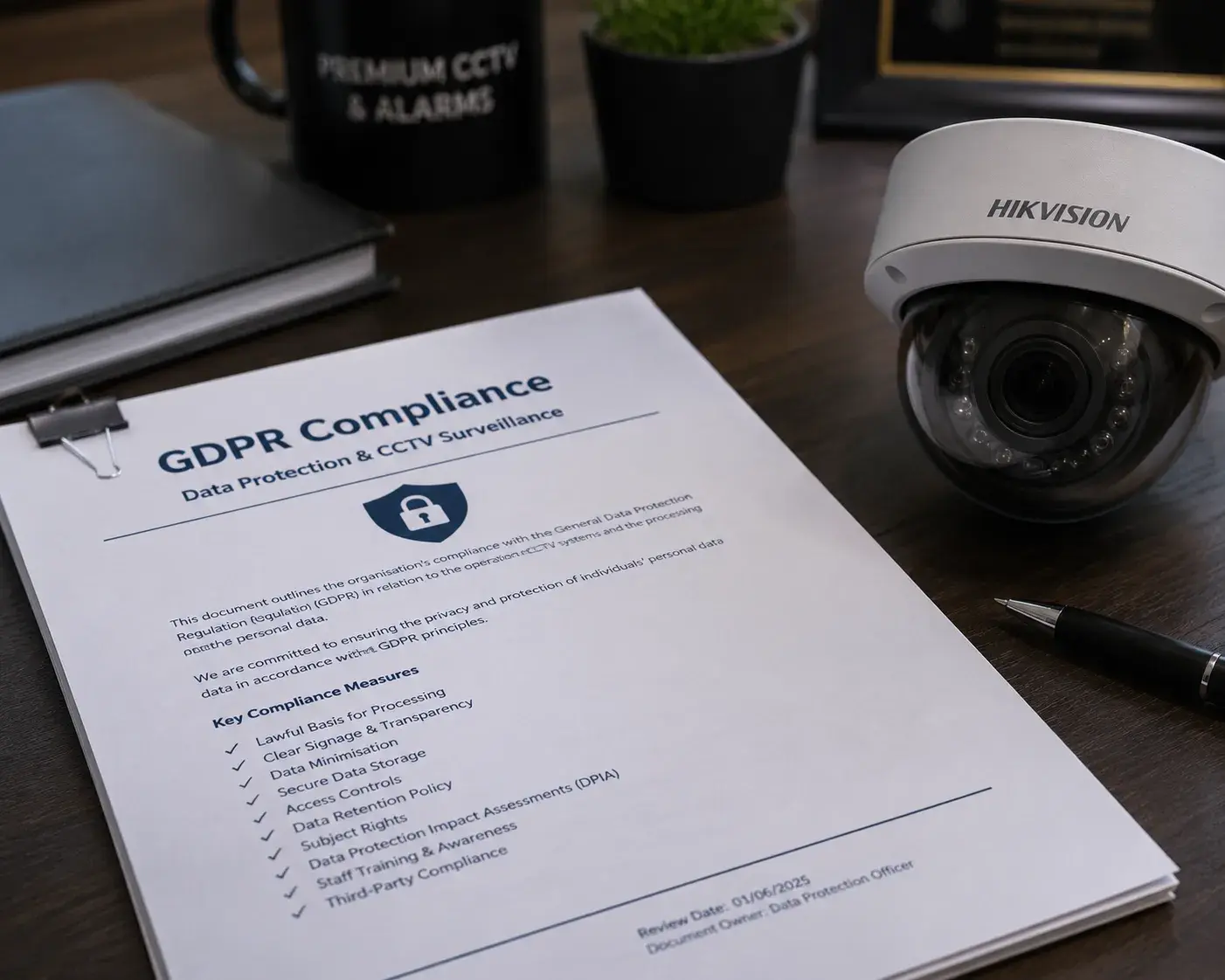
If your CCTV captures images of people in a public space or on your neighbour's property, you become a "data controller" under UK GDPR. This creates obligations around how you store footage, how long you keep it, and who can access it.
ICO (Information Commissioner's Office) guidance
The ICO publishes specific guidance for domestic CCTV. In summary:
- If your cameras only cover your own property and immediate curtilage, GDPR does not apply
- If cameras capture public areas (a road, shared driveway, neighbour's garden), GDPR obligations apply
- You don't need to register with the ICO for purely domestic CCTV, but obligations around data minimisation and retention still apply under the DPA 2018
What does "captures public areas" mean in practice?
A camera pointed at your front door that also captures part of the pavement or road — yes, that counts. In practice, this applies to the majority of residential installations.
This doesn't mean you can't install cameras in these positions. It means you should:
1. Use warning signs — "CCTV in operation" signs should be visible at the point someone enters your camera's coverage area 2. Minimise capture — Use camera angle and lens choice to capture the minimum public space necessary. A varifocal lens lets us fine-tune this precisely during installation 3. Limit retention — 30 days is the standard recommended retention period for domestic CCTV footage 4. Secure storage — Footage should be stored on a password-protected NVR (Network Video Recorder), not accessible via default credentials
Neighbour disputes and CCTV
This is the most common issue we hear about. If a neighbour complains that your camera is pointing at their property, the ICO can investigate. If they find your camera unnecessarily captures private areas of a neighbouring property, they can require you to adjust the angle.
Our advice: during installation, we position cameras to minimise capture of adjacent properties as much as possible. If a neighbour raises concerns after installation, the first step is always to adjust the angle — not remove the camera.
What about CCTV signage?
For domestic properties, signage isn't strictly mandated by law — but it's strongly recommended by the ICO as good practice and is considered when assessing compliance.
Signs should be:
- Clearly visible
- Large enough to be readable from the entry point
- Include contact information if you are processing under GDPR
Do I need planning permission for CCTV cameras?
In most cases, no. CCTV cameras on dwellinghouses are generally permitted development under the Town and Country Planning (General Permitted Development) Order 2015, provided:
- Cameras are not on a listed building without consent
- Cameras do not project more than 1 metre from the wall
- No camera is installed on a chimney, wall, or roof slope facing a highway (some exceptions apply)
Ring doorbells and smart cameras — different rules?
No. The same rules apply to any camera that captures images of people — Ring, Nest, Arlo, or professional CCTV. The camera's brand doesn't change your obligations as a data controller.
One additional consideration with cloud-based cameras (Ring, Nest): footage is transferred to US-based servers. This can have additional GDPR implications if you're capturing images of third parties. Professional NVR-based systems store footage locally, which is simpler from a compliance perspective.
Summary: staying compliant is simple
1. Install warning signs at your property entrance 2. Angle cameras to minimise capture of public/neighbouring areas 3. Store footage on a secure, password-protected NVR 4. Keep footage for no more than 30 days unless needed for an incident 5. If asked for footage by police, provide it promptly
We handle all of this as standard on every installation. Our systems come configured with 30-day rolling storage, secure access credentials, and we advise on signage positioning as part of the commissioning process.
Questions about compliance? Call Ben on 07464 366095.
Need advice for your property?
Get a free security survey from Ben
Nearly 1,000 installations across South Wales. AJAX & Uniview certified. Prices from £589.