
Why small businesses are ditching traditional keys
Keys are convenient until they become a problem. Former employees might retain copies. Lost keys require a locksmith and potentially new locks for the whole building. There's no audit trail of who entered and when. If you have multiple entry points, key management becomes an administration headache.
Access control systems solve all of these problems — and the cost has dropped significantly in recent years, making them viable for businesses of any size.
What is access control?
Access control is any system that restricts entry to a building or area based on a credential. The credential might be:
- A proximity card or fob (most common)
- A PIN code (often used as a secondary factor)
- A smartphone (mobile credential) via Bluetooth or NFC
- A fingerprint or biometric
- A face recognition camera
The core components
Access controller (panel): The brain of the system. Stores credential data, manages permissions, and logs events. Can be standalone (programmed locally) or networked (managed via cloud software or server).
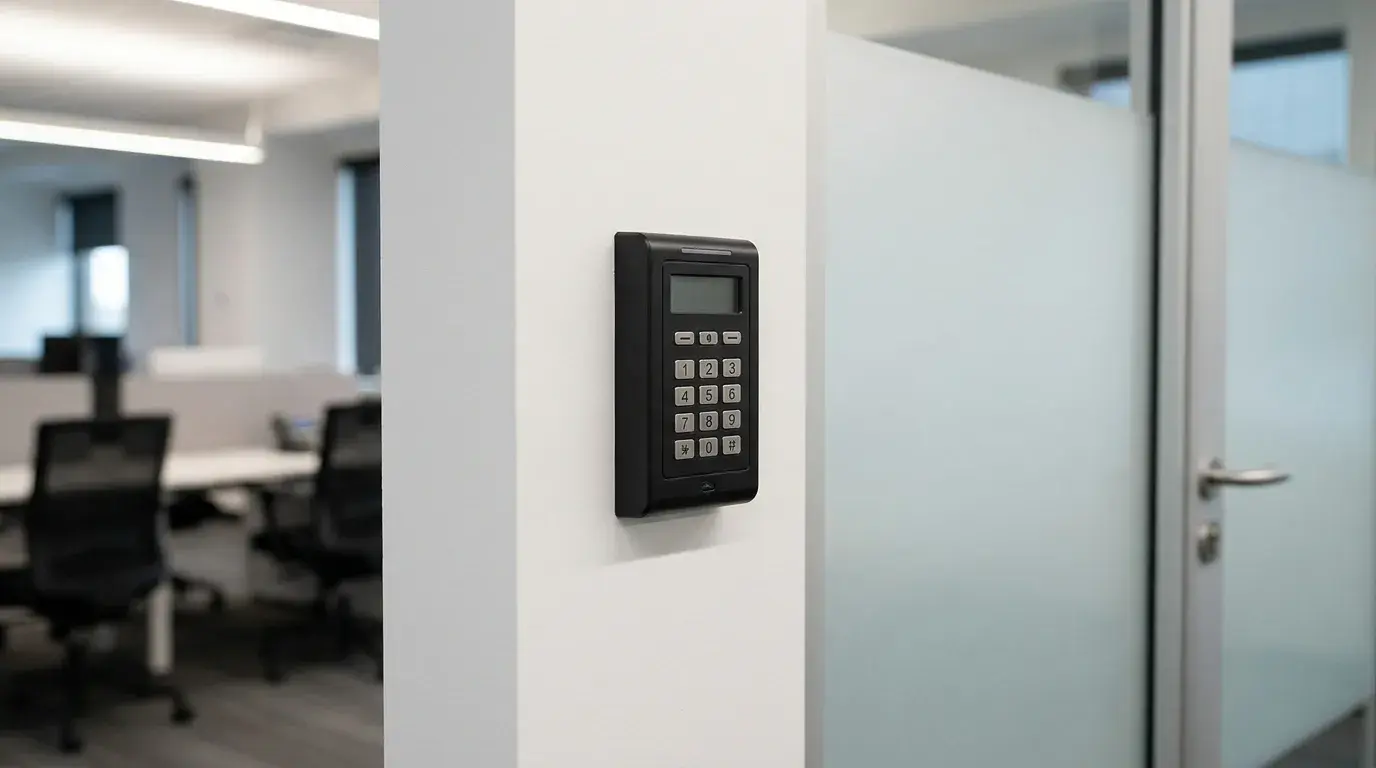
Card readers: Installed at each door you want to control. Modern readers are compact and unobtrusive. IP-rated models are available for external use.
Electronic locking: The most common choices are magnetic locks (fail-safe — release on power loss), electric strikes (fail-secure — lock on power loss), and motorised deadbolts. The right choice depends on your fire safety requirements and security grade.
Door controllers and wiring: Each reader connects back to the access panel via data cable (or wireless in newer systems).
Management software: Where you add users, set schedules, view logs, and revoke credentials. Cloud-based systems let you do this from a phone.
What you can actually control with modern access control
Time schedules: A cleaner might only have access from 6am–9am weekdays. A manager has 24/7 access. These permissions are set per credential and automatically enforced.
Area restrictions: Staff can enter the main building but not the server room or cash office. Access control enforces this without any physical keys.
Real-time audit logs: Every entry and exit is logged with time, date, and credential used. If there's a security incident, you have a precise record of who was in the building.
Instant revocation: A staff member leaves — you remove their card/fob from the system in 30 seconds. No lock changes, no keys to retrieve.
Remote access grants: A deliverer arrives early — you can let them in remotely via the app without being on site.
Integration with CCTV: Entry events can be tagged in your CCTV timeline. When you see an alarm event on a specific date and time, the CCTV and access log are synchronised.
Cost guide for small businesses
For a typical small South Wales business with one main entrance and one staff entrance:
Basic two-door system (proximity fob, standalone control, no software): £800–£1,400 installed
Networked two-door system (fob + PIN, cloud-managed, app access): £1,200–£2,000 installed
Three to five door system (cloud-managed, audit logs, integration ready): £2,000–£4,000 installed
These figures include supply, installation, commissioning, and 12 months warranty. Ongoing costs are minimal — cloud software subscriptions run £10–£30/month for most small business platforms.
AJAX integration
Our AJAX alarm systems can integrate with access control. When the alarm is armed, the access system knows — preventing false alarms from staff using their fob to enter in the morning. When the last person leaves and arms the alarm, the access system can lock all doors automatically.
This integrated approach is what we recommend for commercial premises where security and operational efficiency are both priorities.
Is access control complicated to manage day-to-day?
No — and this is one of the biggest misconceptions. Modern cloud-managed systems have simple, app-based interfaces. Adding a new employee takes two minutes. Viewing the entry log is as simple as scrolling a list. Most of our commercial customers manage their system entirely themselves within a few days of handover.
We provide full training as part of every installation.
For a free survey and access control quote for your South Wales business, call 07464 366095 or use our contact form.
Need advice for your property?
Get a free security survey from Ben
Nearly 1,000 installations across South Wales. AJAX & Uniview certified. Prices from £589.